It is the complaint every facility manager in Northeast Ohio hears in July, and it is the one that makes the least sense on paper: the thermostat says 72 degrees, and the building still feels awful. Papers curl. Conference rooms feel close and stuffy. Somebody in accounting has a space heater running in the middle of summer because the air feels cold and wet at the same time. And when the complaints reach the front office, the instinct is always the same — the air conditioning must be undersized, so let's put in something bigger.
That instinct is almost always wrong, and acting on it usually makes the problem worse. The building isn't struggling to get cold. It's struggling to get dry — and in most commercial buildings the reason is cooling equipment that is too large, not too small.
Your thermostat only measures half the problem
There are two kinds of heat in a building, and comfort depends on both.
Sensible heat is the kind you can feel on a thermometer. It's the temperature reading. It's what your thermostat measures, and it's the only thing your thermostat controls.
Latent heat is the energy stored in water vapor in the air. It doesn't register on a thermometer at all. A room at 72°F with damp air and a room at 72°F with dry air read identically to a thermostat — and feel completely different to the people in them. Humid air slows the evaporation of sweat from skin, which is the mechanism your body actually relies on to feel comfortable. That's why 72°F and muggy feels worse than 75°F and dry.
So when a thermostat is satisfied and the building still feels miserable, the system is doing exactly what it was told to do. It was told to hit a temperature. Nobody told it to remove moisture — and, crucially, nothing in the building is measuring whether it did.
How a cooling system removes moisture — and why it needs time
Air conditioning doesn't dehumidify on purpose. It dehumidifies as a side effect.
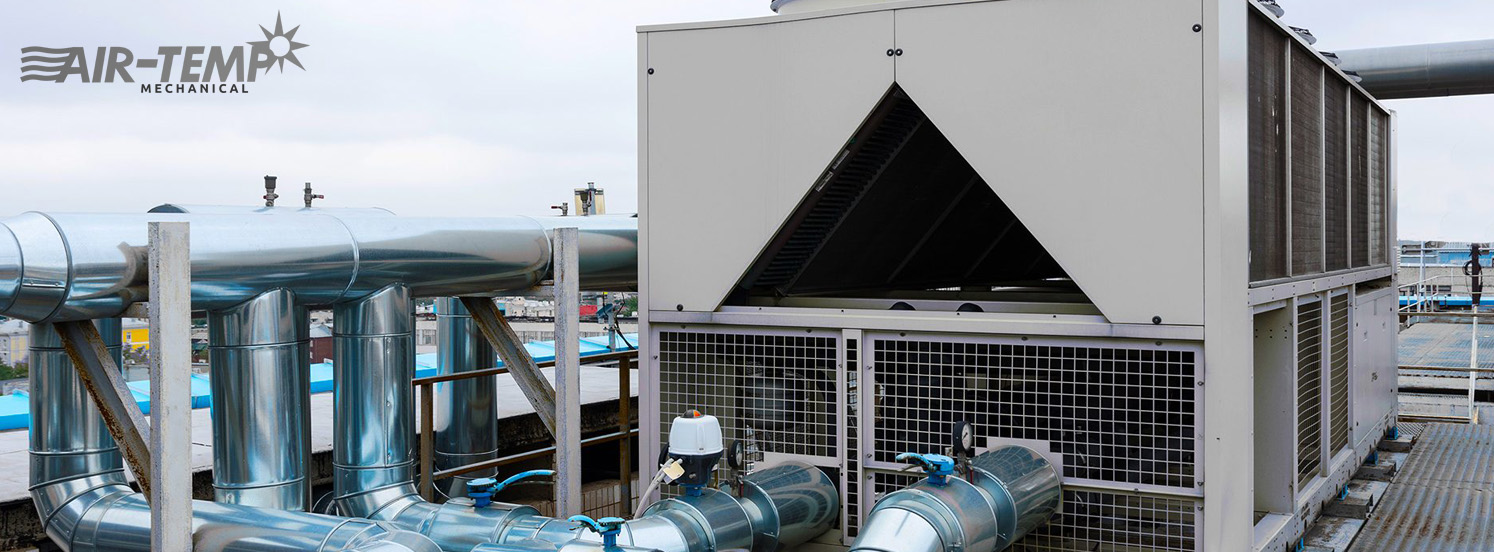
When warm, humid air passes across a cold evaporator coil, the coil surface sits below the air's dew point. Water vapor condenses on the coil, runs into the drain pan, and leaves the building through the condensate line. That's the whole mechanism. If your rooftop unit is doing its job on a humid day, it is quietly pouring water off the roof.
Here is the part that matters: condensation takes run time. The coil has to get cold, stay cold, and keep pulling air across itself long enough for moisture to actually collect and drain away. A unit that fires up, blasts the space to setpoint in six minutes, and shuts off has barely started removing water. Worse, when it shuts off, the fan may keep running over a wet coil — and the moisture that had condensed gets blown right back into the building.
This isn't a theory. ENERGY STAR's guidance on equipment sizing puts it plainly: with oversized units, short cycling "reduces the amount of condensation that drains off the coils and even allows some moisture to evaporate back into the air."
The counterintuitive culprit: equipment that is too big
This is where the "just install something bigger" instinct backfires.
An oversized cooling system satisfies the thermostat too quickly. It drives the space to temperature in a short burst, shuts down, and sits idle — never running long enough to pull meaningful moisture out of the air. The building gets cold fast and stays damp. That is the textbook signature of oversizing, and it is exactly the "cold but clammy" complaint.
And it is not a rare condition. When Pacific Gas & Electric instrumented a large population of commercial rooftop units in the field, it found that more than 40% of them were oversized by more than 25% — beyond even the generous margin the industry considers acceptable practice. In a sizable share of cases, the unit could have been half the size.
So when a building feels humid and someone proposes more tonnage, the honest response is a question: are we sure the current equipment isn't already too large? Adding capacity to a short-cycling system makes it cycle harder, dehumidify less, and wear out its contactors faster — and you pay more up front and more in demand charges for the privilege.
Why turning the thermostat down makes it worse
The natural response to a clammy building is to push the setpoint lower. It feels like it should help. It usually doesn't.
Dropping the setpoint doesn't make the system remove more moisture per hour — it just makes it reach a colder target and shut off. In a building that's already short-cycling, a lower setpoint can mean the unit is satisfied even faster, giving the coil even less time to condense water. You end up with a space that is genuinely too cold, still humid, and now costing considerably more to run. That's the building where people are wearing sweaters in August and complaining about the humidity in the same breath.
The outdoor air you're required to bring in
There's a second reason July is hard on commercial buildings specifically, and it has nothing to do with your equipment.
Every commercial building is required by code to bring in outdoor air for ventilation — ASHRAE Standard 62.1 sets the minimum, and for a typical office it works out to roughly 5 cfm per person plus 0.06 cfm per square foot of floor area. You cannot opt out of it. Which means that on the most humid afternoon of the year, your building is obligated to draw in thousands of cubic feet per minute of the wettest air available and dry it out before it reaches the space.
And Northeast Ohio air in July is genuinely wet. Cleveland's design dew point — the humidity level engineers size dehumidification around — sits in the low 70s. That is a real, code-mandated moisture load arriving at your coil every minute the building is occupied, and it is a load a homeowner's air conditioner never has to deal with. It is one of the clearest reasons commercial HVAC is a different engineering discipline than residential comfort, not a scaled-up version of it.
The measurement most people get wrong
If a technician checks your system on a humid day, there's a good chance they'll measure the "temperature split" — the difference between the air going into the return and the air coming out of the supply — and compare it to the familiar rule of thumb: it should be somewhere around 18 to 22 degrees.
That rule is not universal, and on a humid day it is actively misleading.
The correct target split depends on how much moisture is in the air entering the coil. When the coil is working hard to condense water, it spends much of its capacity on latent heat — removing moisture — rather than on dropping the dry-bulb temperature. So the split gets smaller as humidity rises. Under muggy conditions, a target split closer to 12 degrees can be entirely correct, where 20 degrees would be right in dry weather.
The practical takeaway for a building owner: if a technician tells you the split "looks fine" — or "looks bad" — ask what the return wet bulb was. A tech who measured only dry-bulb temperature has told you very little, and a system condemned on a 12-degree split in August may be perfectly healthy. This is the single easiest way to tell whether the person on your roof is measuring or guessing.
What actually fixes a humid building
Almost none of the real fixes involve buying more tonnage.
- Run time. Longer, slower cooling cycles remove far more moisture than short, hard ones. On variable-capacity or staged equipment, this is often a controls and staging problem, not a hardware problem.
- Airflow. Pushing too much air across the coil raises the coil temperature and reduces condensation. Counterintuitively, slowing supply airflow can improve dehumidification. This is a commissioning setting, and it is frequently wrong.
- A working economizer. An economizer stuck open in July is force-feeding your building hot, humid outdoor air while the coil tries to cool it. Field studies find economizer failure rates averaging around 60%, and they fail silently — nobody notices, because the unit still "runs." If yours hasn't been checked in a few years, the odds say it's broken.
- Condensate drainage. A clogged drain pan means water that was removed is sitting in the airstream, evaporating straight back into the building. It also grows biological problems you don't want in your ductwork.
- Dedicated dehumidification. For spaces that genuinely need tight humidity control, hot-gas reheat or a dedicated outdoor air system is the engineered answer — a system that dries the air and then brings it back to a comfortable temperature, rather than overcooling to squeeze water out.
- An actual load calculation. If nobody has performed one since the building was constructed, no one in the building knows whether the equipment is right-sized, oversized, or has been outgrown by a change of use.
What to do this month
If your building is cold and clammy right now, resist the urge to buy tonnage. Instead, get four things checked before August:
Is the equipment short-cycling? A properly sized unit under real summer load should be running long cycles, not firing on and off every few minutes. Frequent cycling at peak conditions is one of the most reliable indicators that a unit is oversized.
Is the economizer doing what it should? Not "is it installed." Is it working, and is it closed when the outdoor air is hot and wet.
Is the condensate actually draining? Water should be leaving the building. If the pan is standing full or the drain is dry on a humid day when it shouldn't be, something is wrong.
Was the split measured with a wet bulb? If not, you don't yet have a diagnosis — you have a number.
Comfort complaints in July are rarely about temperature. They're about moisture, and moisture is a design and maintenance problem long before it becomes an equipment problem. The buildings that stay comfortable through a Northeast Ohio August aren't the ones with the biggest units on the roof. They're the ones where someone checked.
Air Temp Mechanical has served Northeast Ohio commercial and industrial facilities since 1978. If your building is holding temperature but not comfort, we're glad to walk the roof, measure what's actually happening at the coil, and tell you plainly what we find — including when the honest answer is that your equipment is fine and something else is at fault. Get in touch.